Study figure and data
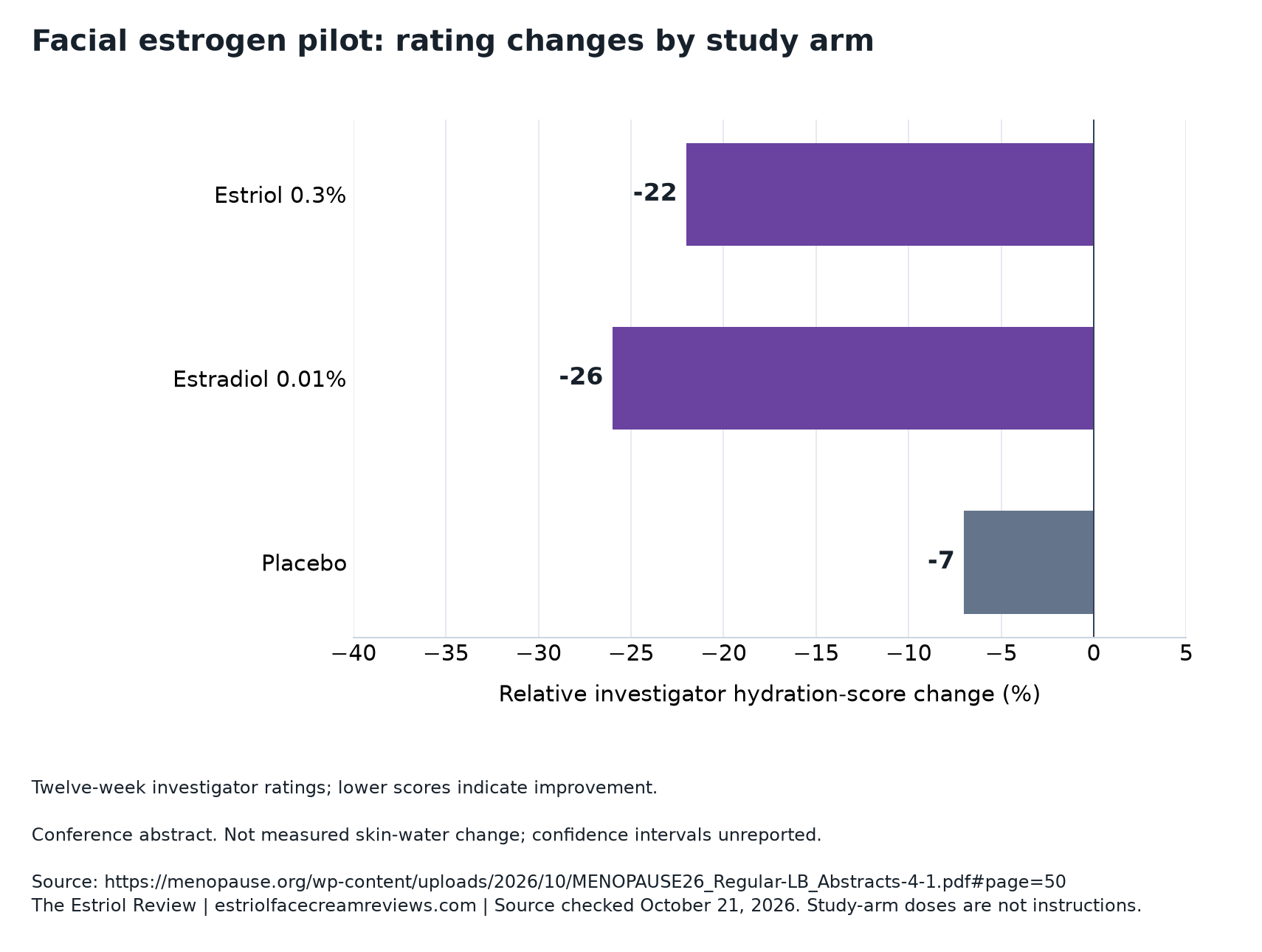
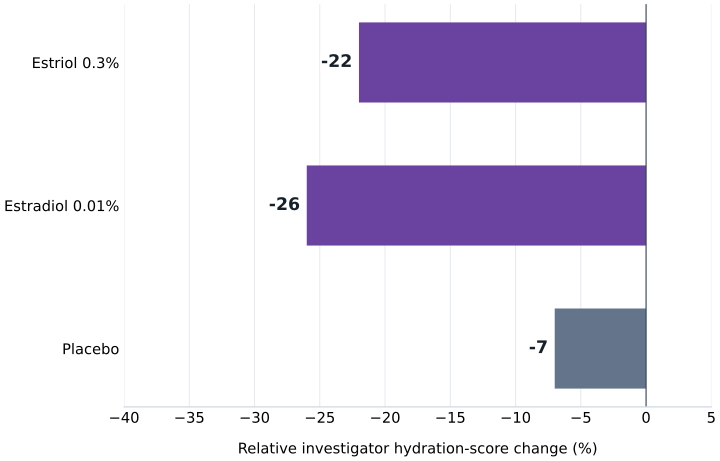
Facial estrogen pilot: rating changes by study arm
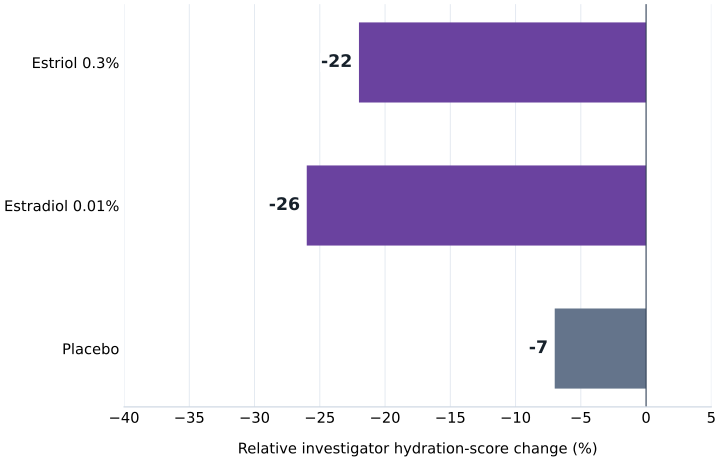
Twelve-week investigator ratings; lower scores indicate improvement.
Conference abstract. Not measured skin-water change; confidence intervals unreported.
Download chart (PNG)Download data (CSV)Download vector chart (SVG)
| Historical cream arm | Reported value |
|---|---|
| Estriol 0.3% | -22 |
| Estradiol 0.01% | -26 |
| Placebo | -7 |
Begin with the experiment, then identify the product
P-124 is a randomized, double-blind, single-site conference pilot: 90 postmenopausal women aged 50–60, 30 per arm, 86 completing. Our interpretation starts with the purpose of that design. Random assignment is intended to make an intervention comparison more informative than simply observing people who chose different products. Blinding is intended to reduce the influence of knowing an assignment. Neither design feature, by itself, identifies a retail formulation. One describes how an experiment allocates and assesses treatment; the other requires a documented connection between the experimental preparation and a commercial item.
For an original matching exercise, imagine two records placed side by side. The first gives a research preparation a code; the second gives a purchasable cream a name. A reliable comparison needs a document connecting those identifiers, alongside the relevant formula details. Similar names are a reason to investigate, not a substitute for that connection. The same discipline applies when evaluating the population: ask which inclusion criteria matter to the proposed claim instead of treating an age label as a universal category. The guide to reading estriol claims provides a place to organize those questions.
Treat concentration as one field in a longer record
A concentration is a statement about the proportion of an ingredient in a preparation. It is not a description of every ingredient, the entire study procedure or the manufacturing record. Our interpretation is to compare those fields independently. Two labels could agree on a percentage while leaving the base, additional ingredients or dispensed preparation incompletely described. That observation does not establish that their effects differ. It establishes that the percentage alone has not demonstrated their equivalence. Predicting a biological difference would require evidence beyond this matching exercise.
Consider an explicitly hypothetical comparison: a study calls its preparation Formula A, while a product label names Formula B and lists the same active percentage. The correct next entry is “identity unresolved,” not “identical” or “inferior.” If another active ingredient appears, its contribution also remains a separate question. The discussion of combined estriol and tretinoin creams can help structure that record. For a named offer, use the Winona review to inspect its documented description and terms; the link does not establish a connection to the experimental preparation.
| Field | Document to seek | Question left open without it |
|---|---|---|
| Ingredient | Exact substance named in both records | Are the names identifying the same substance? |
| Concentration | The stated proportion and units | Is the numerical comparison like for like? |
| Formulation | Preparation description, including other ingredients | What remains unspecified? |
| Population | Study eligibility and participant description | Whom does the evidence describe? |
| Endpoint | Measurement definition and comparison | What outcome was actually assessed? |
| Commercial identity | Explicit link between research and product identifiers | Was this particular preparation studied? |
Keep the score, the person and the physical measurement separate
Primary investigator ratings used a 0–4 scale. Our interpretation of any rating-based result begins with what the scale represents. An assessor assigns a category; a physical measurement records a quantity using a particular method; a responder count classifies people under a defined rule. These are three different ways of describing an outcome. A percentage attached to one cannot be silently relabeled as either of the others. Before reading the height of a bar, identify the noun in its axis label and keep that noun in the conclusion.
For an original arithmetic illustration, an invented index moving from 80 to 60 falls by 25 percent: the decrease of 20 is divided by the starting value of 80. This calculation does not say that 25 percent of people responded or that a physical property changed by 25 percent. Nor does a percentage calculation demonstrate that adjacent rating categories represent equally large clinical differences. That question needs a definition of the scale and evidence about its interpretation. A product claim should preserve those measurement boundaries instead of replacing a technical label with a more attractive everyday outcome.
Compare changes before comparing the size of claims
Our methodological interpretation separates three quantities: a starting value, a change within a group and a difference in change between groups. A visually impressive before-and-after number describes only the middle quantity. The comparison with a control asks a further question. This distinction matters even when both groups move in a favorable direction: a reader must know which calculation supports the statement being made. It also matters when a chart selects only one outcome from a broader investigation.
Here is an invented example, unrelated to the reported estimates. Suppose one group has a 30 percent decrease in a score and a comparison group has a 10 percent decrease. Subtracting their relative changes gives a difference of 20 percentage points on that change scale. It does not establish a 20 percent advantage in physical skin hydration, a 20 percent response rate or an individual prediction. Even that subtraction does not supply uncertainty around the comparison. To assess how precisely it was estimated, the reader needs the appropriate interval or enough reported statistical information to calculate it legitimately. Attractive bar spacing cannot provide the missing information.
Read an outcome family without turning it into one verdict
Between-group participant efficacy and fine-line, wrinkle, pore and tone comparisons were nonsignificant. Estriol firmness conflicts between narrative and table (P=0.077). Our interpretation is to preserve each outcome separately, including a disagreement within a report. A summary sentence and a table are both evidence about what authors reported; where they disagree, selecting the more favorable version would conceal the problem. The unresolved discrepancy should remain visible until an authoritative correction or fuller report resolves it.
A broader methodological question concerns how outcomes were selected and analyzed. When an investigation examines several measurements, the reader needs to know which comparisons were planned, which were exploratory and how the analysis addressed repeated testing. A collection of favorable results is not automatically a single validated measure of overall benefit. Equally, a nonsignificant comparison is not proof that two treatments have exactly equal effects. A P value describes a statistical test under its assumptions; it is not the probability that a particular cream works for a particular reader. The useful conclusion stays tied to its endpoint, comparator and uncertainty. This preserves information that a simple successful-or-unsuccessful label would discard.
Define what a safety observation could detect
Tolerability scales reported no issues; serum comparisons versus placebo were nonsignificant. P-124 leaves ± undefined. Separately, the 1993 indexed abstract followed 17 women for three months: nine received estradiol ointment and eight estriol ointment. Serum hormones and vaginal smears showed no significant changes; randomization, blinding and a vehicle control are not established by that abstract. These are bounded observations, not a demonstration of zero absorption or long-term safety.
Our interpretation asks three distinct questions of a safety record: what was measured, when it was measured and what size of difference the design could meaningfully exclude. A symptom scale, laboratory measurement and clinical event record are not interchangeable. An unreported statistical definition also prevents a reader from deciding what a plus/minus term represents. It should not be converted into a confidence interval by guesswork. Likewise, absence of statistical significance does not itself establish equivalence; that requires a suitable design and a defined margin. For a product comparison, safety claims need the same identity checks as benefit claims. A different preparation cannot inherit an exposure estimate simply because it appears in the same ingredient category.
Use the older studies to ask a different question
The 1996 indexed abstract describes 59 preclimacteric women comparing estradiol 0.01% and estriol 0.3% compounds over six months; ten underwent biopsies. It reports increased type III collagen labeling and increased prolactin. Its combined wrinkle-depth/pore-size result lacks separate estimates and denominators. The abstract does not establish randomization, blinding or a vehicle comparator. Those details limit the comparisons that can be reconstructed from the accessible record.
Our interpretation treats an older report as a distinct experiment, not an interchangeable extra row in a modern chart. A longer observation period does not repair an unspecified comparator. A tissue measurement does not automatically explain a visible change. And an incomplete numerical description should not become a precise product promise. Before combining studies, specify the common question and check whether their designs actually answer it. A useful evidence record can acknowledge that two studies concern related ingredients while leaving their estimates separate. That is more informative than adding unlike percentages or counting favorable publications as if each supplied an equal vote. The prescription checklist can hold the resulting questions for discussion without treating historical research strengths as directions for use.
Match the anatomical site and the level of measurement
The 2008 full paper studied 70 people across experiments, not one 70-person facial trial. Its separate facial experiment involved five women and five men for two weeks; facial procollagen changes were nonsignificant. Protected-hip findings concerned molecular and protein measurements. Facial estradiol increased serum levels in that historical experiment. Pfizer partly funded the work, and a coauthor disclosed Pfizer consulting. The companion analysis of estradiol and skin sites examines the experiment-level details.
Our interpretation distinguishes three levels of evidence: activity in a biological pathway, a measured tissue response and a clinical outcome a person values. Demonstrating one level does not logically establish every later level. The same applies to anatomical location. A claim about the face requires an argument supported by facial evidence; a result from another site cannot be renamed to fill that role. Differences between experiments may generate explanations worth testing, but they do not, by themselves, prove why results differed. For product matching, record both the physical site and the measurement method. This prevents a molecular term from disappearing as the finding moves from a research summary into a cosmetic promise.
Keep approval and manufacturing claims in their own columns
FDA reports no approved estriol-containing drugs and does not establish estriol as safer than other estrogens. FDA also explains that compounded medicines lack its premarket approval review of safety, effectiveness and quality; they are not approved generics. Compounding can address individual needs when an approved medicine is medically inappropriate. These regulatory distinctions do not decide the outcome of a particular experiment or verify a named preparation.
Our editorial interpretation is to maintain separate records for clinical evidence, regulatory status and the preparation actually dispensed. A research result cannot substitute for a quality record; a quality record cannot establish a clinical effect. The distinction works in both directions: lack of approval is not a mathematical estimate of benefit, and a favorable experiment is not an approval decision. The guide to cosmetics and estriol prescriptions helps organize these categories. When assessing an offer, ask what each document actually establishes rather than treating a single reassuring label as a complete answer. None of these general sources verifies an individual pharmacy, current product formula or the legal circumstances of a particular prescription.
| Claim being evaluated | Relevant documentation | Separate question still remaining |
|---|---|---|
| A clinical benefit was demonstrated | An identifiable study with a defined endpoint and comparison | Does the study match the product and population? |
| This is the studied preparation | An explicit connection between research and commercial identifiers | What did the study actually demonstrate? |
| The dispensed preparation meets a quality specification | Documentation for that preparation and specification | Does quality documentation establish a clinical outcome? |
| An approval statement applies | The relevant official product record | Does it apply to this exact preparation and claimed use? |
Finish the comparison with a documented identity link
Alloy Health funded P-124. Our interpretation is that a funding disclosure establishes that relationship; it does not independently identify a tested retail product. Funding should be recorded transparently and examined alongside the design, reporting and reproducibility of the work. It is neither a reason to erase the findings nor a substitute for inspecting them. Product identity remains a documentary question with its own evidence requirements.
A practical editorial record ends with three statuses: matched, different or unresolved. Use them for each field rather than issuing one broad verdict. If the ingredient matches but the complete formula is unresolved, preserve both entries. If a product changes, date the description and repeat the relevant comparison instead of carrying forward an old conclusion automatically. The CoreAge Rx review is a place to inspect documentary offer details, not evidence that its product participated in this trial. Keeping commercial terms beside, but distinct from, the scientific record makes the unresolved questions usable. It also prevents a reader from mistaking a convenient purchase description for a completed chain of clinical evidence.
Questions about the evidence
Does a matching ingredient percentage identify the studied cream?
No. In our evidence-matching framework, percentage and preparation identity occupy separate fields. Agreement in one field cannot fill missing information in another. Look for an explicit documentary connection and the relevant formula description; leave the match unresolved when those records are unavailable. This does not assert that two preparations must have different effects.
How should I read the chart without turning it into a product ranking?
Read the endpoint, comparator and time period together before interpreting the bars. Our methodological recommendation is to write one sentence using the measurement’s own name, then check whether the proposed product claim changes that name or population. A chart ranks displayed values; it does not complete the product-identity investigation.
What would make two studies meaningfully comparable?
Start with a shared question, then examine population, intervention, comparator, timing and outcome definitions. Our interpretation is that agreement on an ingredient is insufficient. Differences may be scientifically informative, but pooling results requires an explicit justification. Keeping incompatible estimates separate preserves their meaning instead of manufacturing a larger-looking evidence base.
What should an unresolved laboratory result mean for a reader?
It should remain unresolved at the level the evidence supports. Our interpretation avoids replacing missing precision with reassurance or alarm. Record the measurement, its timing and the reported statistical definition. Personal treatment decisions require clinical context; a literature comparison cannot establish an individual exposure level or an individual safety conclusion.
Which questions belong beside a provider review?
Record the dated product description, who is responsible for the preparation, the terms of the offer and the documents supporting any claimed research connection. This is an editorial organization method, not verification of a particular provider. Keep each unanswered question visible rather than treating a complete-looking page as a complete evidence record.
Editorial assessment
The strongest reading of this evidence preserves the connections that have actually been demonstrated and names the ones still missing. Begin with the experiment and its outcome, then work outward to the formulation and the proposed commercial claim. Our interpretation does not turn an ingredient match into a product endorsement, or an unresolved link into proof of ineffectiveness. A useful conclusion may be narrower than a sales claim: a particular question was studied under particular conditions, while other questions remain open. That precision gives readers a defensible record to discuss with a clinician and a clearer basis for examining future research.
Research access and limitations
P-124: conference abstract/table, not a full trial report. The 2008 publisher paper was read in full; the 1993 and 1996 analyses use indexed abstracts only, with funding/conflicts unavailable. FDA pages supply regulatory context. Research concentrations identify historical study arms, not prescribing instructions. Illustrations and matching checklists are original editorial analysis, not additional clinical findings. No independent clinical review or current provider verification is claimed.