Study figure and data
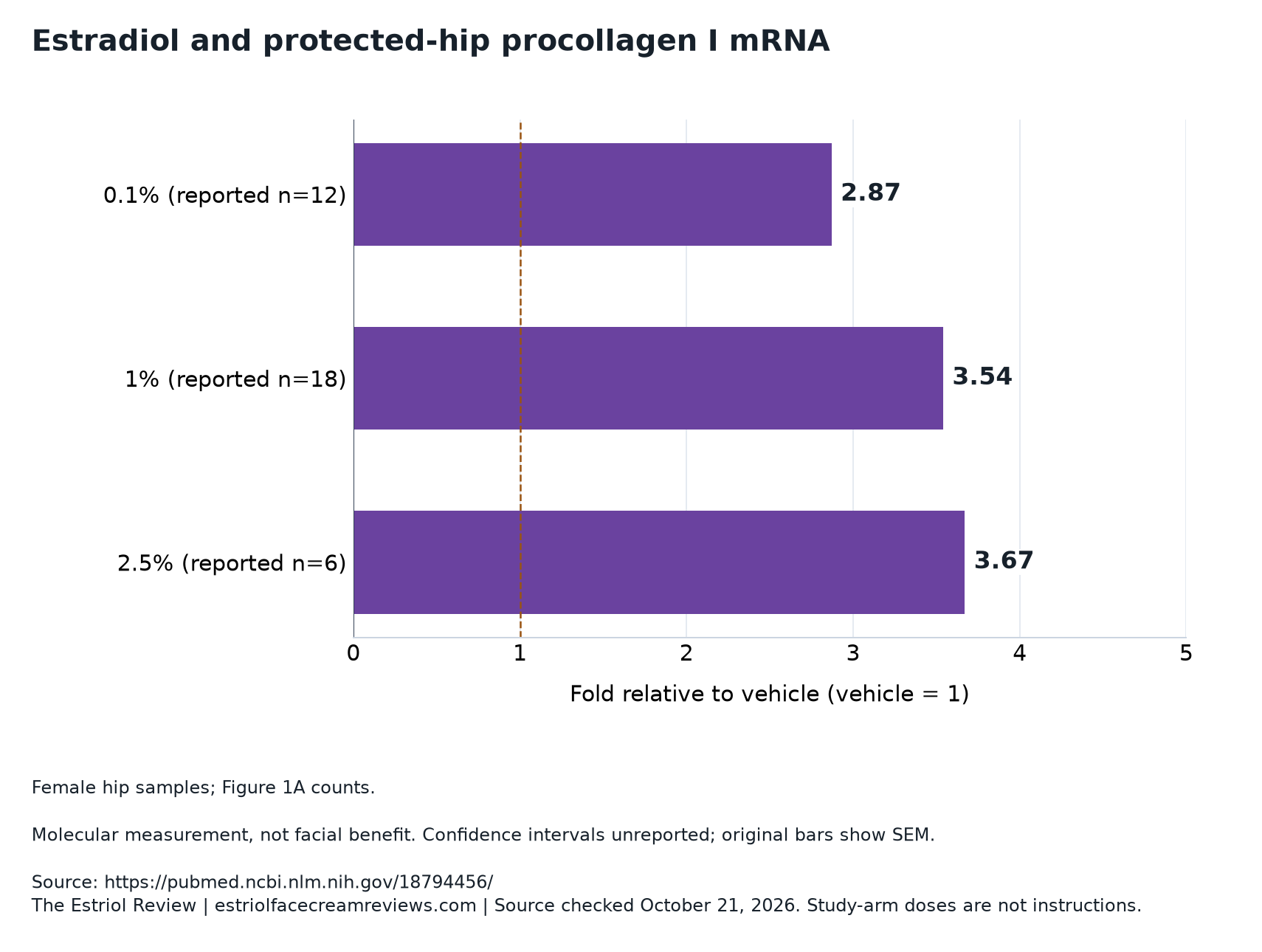
Estradiol and protected-hip procollagen I mRNA
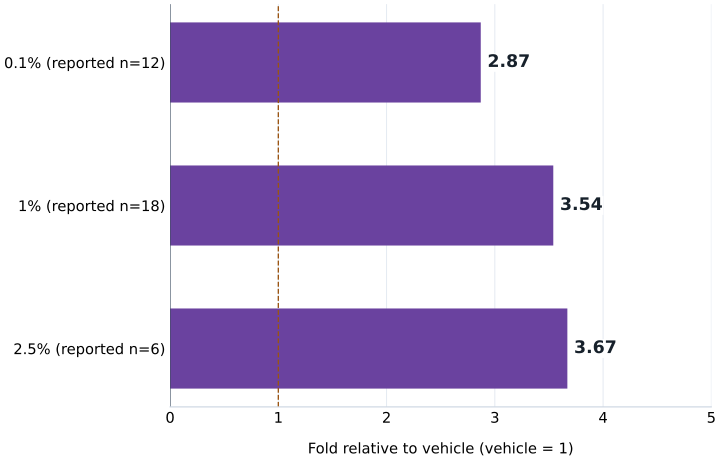
Female hip samples; Figure 1A counts.
Molecular measurement, not facial benefit. Confidence intervals unreported; original bars show SEM.
Download chart (PNG)Download data (CSV)Download vector chart (SVG)
| Historical estradiol concentration | Reported value |
|---|---|
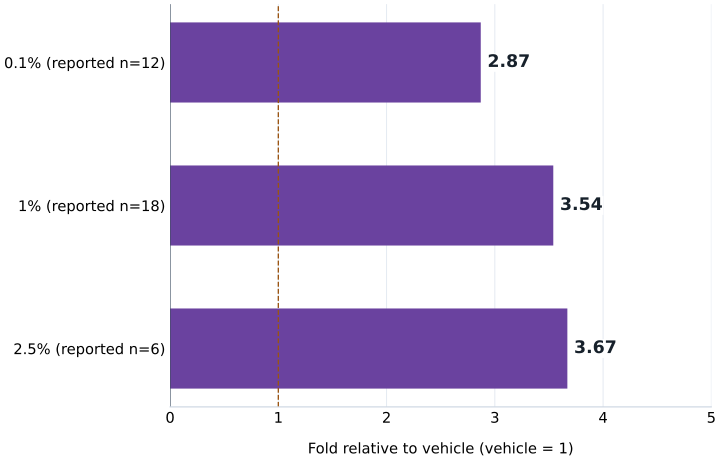
| 0.1% (reported n=12) | 2.87 |
| 1% (reported n=18) | 3.54 |
| 2.5% (reported n=6) | 3.67 |
Give each experiment its own address
Skin experiments included 70 adults averaging 75 (40 postmenopausal women, 30 men): one-week paired hip/forearm comparisons; separate two-week facial before/after comparisons (five women, five men).
Our interpretation starts by treating an experiment as a complete address. Its participant group, comparison, measurement and timing tell the reader where a result belongs. A paper can contain several addresses; moving a number from one experiment into the description of another loses information even if the citation still points to the correct publication. The practical question is not simply how many people appear somewhere in the paper, but which people contributed to the estimate under discussion.
For an original methodological example, imagine a report containing a laboratory substudy and a separate appearance assessment. The enrollment headline would not establish the denominator of either analysis. A reviewer should place the sample description beside each outcome, and should leave an unknown denominator visibly unresolved. This avoids turning the breadth of an overall research program into apparent precision for a narrower finding. The same discipline supports the claim-reading questions in our guide to facial cream evidence.
Read the unit before interpreting the bar
Messenger RNA carries genetic instructions; measuring that signal is a different task from a photograph, a symptom rating or a person's satisfaction. Our interpretation is that the first reading task should be to finish the sentence “this number measures…” without substituting the outcome a reader hopes to see. If that sentence changes while moving from the graph to a product description, an additional evidentiary step has been introduced.
Consider an original mathematical illustration unrelated to observed study values: a hypothetical signal of six units compared with two gives the same threefold ratio as three compared with one. The ratio alone does not recover either underlying amount. Nor does it supply a probability that an individual will notice a benefit. To compare a ratio with an appearance claim, the reviewer needs evidence connecting the measured quantity to a defined visible outcome, including the time at which both were assessed. That connection should be demonstrated rather than silently supplied by the reader.
Keep conflicting labels visible
Figure 1A’s n=18 conflicts with Table 1’s 17; Figure 1B’s first protein concentration conflicts: caption 0.01%, narrative 0.1%.
Our editorial approach to those discrepancies is to separate identification from reconciliation. A reviewer can identify the graph being reproduced and transcribe its stated units without claiming to know why another part of the paper differs. The record should preserve the disagreement, not choose whichever version makes the argument look stronger. It is especially important to avoid adding sample labels together when the report does not establish whether they represent distinct people or overlapping measurements.
A useful correction would come from an author clarification, a corrected publication or sufficiently detailed underlying documentation. Until then, the uncertainty belongs beside the affected interpretation. This is a different problem from statistical uncertainty: even a precisely estimated number becomes difficult to use when its treatment label is unresolved. The table below is our methodological checklist for locating the problem. Its examples describe review decisions, not additional experimental results, and no missing numerical interval has been reconstructed.
| Record to match | Question to resolve | Appropriate next evidence |
|---|---|---|
| Denominator | Does the label describe people, samples or measurements? | An explicit analysis population and participant accounting. |
| Treatment label | Do the caption and narrative identify the same intervention? | A documented clarification of the conflicting descriptions. |
| Uncertainty display | What quantity do the error bars represent? | The stated statistical definition and analysis method. |
| Outcome unit | Does the claimed benefit use the measured unit? | Evidence connecting the measurement with that benefit. |
A difference between sites does not identify its cause
Facial procollagen responses were nonsignificant despite estrogen-response marker GREB1 activity.
Our interpretation separates a signal that a biological response occurred from the further question of whether the desired outcome changed. An intermediate response can make a mechanism worth investigating without establishing the later clinical result. A sequence of plausible steps is still a sequence of questions until the relevant connections have been tested.
An original study-design thought experiment illustrates the distinction. Suppose two anatomical regions differ in an outcome after treatment. If region, exposure history, tissue characteristics and study procedures differ together, the observation alone cannot allocate the difference to one of those features. A stronger causal investigation would specify the proposed explanation and test alternatives under comparable conditions. Merely naming the regions does not perform that test. For a product review, the useful conclusion is therefore narrower than a general theory of skin aging: ask whether the evidence actually covers the intended site and outcome. A result elsewhere can motivate a facial study while leaving the facial product question open.
Compare the newer facial study on its own terms
Conference abstract P-124 reports 90 postmenopausal women aged 50–60, randomized across estriol 0.3%, estradiol 0.01% and placebo creams for 12 weeks; 86 completed. Investigator hydration ratings changed by −22%, −26% and −7%, respectively, with significant active-versus-placebo comparisons. These are relative rating changes, not measured skin-water percentages. Wrinkle and participant-efficacy comparisons were nonsignificant. Confidence intervals, arm-specific completion counts and multiplicity handling are unreported. No tolerability issues were reported on rating scales; that is not comprehensive adverse-event surveillance. Alloy Health funded the study; a named retail formula is not established.
Our interpretation compares research questions before comparing conclusions. A rating of visible or tactile characteristics and a tissue measurement need not move together. Different endpoints can therefore yield different findings without either report logically refuting the other. The useful comparison asks which uncertainty each design reduces, which remains, and whether a future study could measure both outcomes in the same participants. Calling one report a replication would require closer agreement in the question and methods. Our detailed examination of the facial pilot explains its outcome table and reporting limits separately.
An older percentage needs an identifiable outcome
The 1996 abstract describes 59 preclimacteric women receiving estradiol 0.01% or estriol 0.3% compounds for six months. Its combined 61–100% wrinkle-depth/pore-size statement lacks separate estimates and denominators. Ten participants contributed biopsies; increased type III collagen labeling was reported. Prolactin rose significantly. Randomization, blinding and vehicle control are not established in the abstract; funding and conflicts remain unknown from that accessible record.
Our interpretation is that a range should not become a menu from which to select the most impressive number. Before applying a reported percentage to a product question, a reviewer needs to know its endpoint, baseline, calculation and analysis population. If two outcomes share one summary statement, the statement cannot by itself tell the reader which estimate belongs to which outcome. A bigger-looking percentage does not resolve that identification problem.
This also explains why several positive descriptions cannot simply be counted as independent confirmations. A tissue label, an appearance measurement and a symptom rating answer different questions, even when discussed in one report. The evidence becomes more useful when those outcomes are named separately and their comparisons remain visible.
Exposure evidence belongs to a particular formulation
Historical facial 0.2% estradiol increased serum levels twelvefold in women, twofold in men. The 1993 abstract instead describes 17 women using facial estradiol or estriol ointments for three months, with no significant hormone or vaginal-smear changes. It does not establish randomization, blinding or vehicle control; full-paper funding and conflicts were unavailable.
Our methodological interpretation is that “not statistically significant” and “no exposure” answer different questions. The former concerns a comparison made with particular measurements and statistical precision. The latter is an absolute statement that needs more than a nonsignificant test. Similarly, one formulation's observed change cannot supply a numerical exposure estimate for another formulation merely because both descriptions contain the word estrogen.
To assess exposure for a specific product, useful documentation would identify the tested material, collection schedule, measurement method and comparison, along with uncertainty and the population studied. Those details would also help distinguish an assay result from evidence about a particular long-term clinical event. Neither substituting a body site nor substituting a dispensing label answers the missing questions. Our guide to vaginal and facial estrogen records provides a separate framework for checking the route being discussed.
Connect the research material with the named product
This section is editorial reasoning about documentary matching. The name of a hormone is one field in a product description, not a complete product identity. An evidence trail should show which material was tested and which material the proposed claim concerns. The trail is strongest when those descriptions can be compared directly, rather than inferred from branding, a sponsor's name or a shared percentage.
A hypothetical review might find that the ingredient name matches while the complete formulation and current product identity remain undocumented. The appropriate entry would be “ingredient match established; formula match unestablished.” That is more informative than converting a partial match into a yes-or-no verdict on the whole product. It also identifies an answerable follow-up request. Our guide to combination formulas discusses the questions raised when more than one ingredient appears in the description.
For documentary context, the existing Winona review and CoreAge Rx review can be read alongside this checklist. Those links do not identify either offer as the material studied here or assign either provider a clinical outcome.
| Identity field | What to record | What remains a separate question |
|---|---|---|
| Hormone | Exact ingredient named in each document. | Whether other aspects of the formula match. |
| Formulation | The complete studied and offered descriptions, where available. | Whether the claimed equivalence has supporting evidence. |
| Research setting | Population, anatomical site, duration and comparison. | Whether the intended use is represented. |
| Outcome | The measurement and the precise claim being assessed. | Whether an evidentiary link connects them. |
| Named product | Documentation linking the tested material with the current offer. | Current manufacturing quality and commercial terms. |
Keep regulatory identity separate from efficacy
FDA explains that compounded drugs lack its premarket approval review of safety, effectiveness and quality, and are different from approved generics. Compounding can serve individual needs when an approved medicine is medically inappropriate. Preparation problems may include contamination or incorrect strength; facility registration is not product approval. FDA also has not established that estriol is safer than other estrogens, and natural or bioidentical terminology does not itself establish safety.
Our interpretation keeps these regulatory facts distinct from a trial's outcome. Approval status does not tell a reviewer the magnitude of a particular experimental effect. Conversely, an experimental signal does not establish approval, verify a current batch or settle the legal status of an individual transaction. Each question needs the appropriate type of record.
For a practical document review, maintain separate entries for the evidence supporting a benefit claim, the identity of the prescribed preparation and the applicable product status. A scientific citation should not be used to fill an empty entry in the other categories. Our prescription record checklist helps organize the documents without treating this article as personal prescribing advice.
Ask what evidence would change the conclusion
Pfizer partly funded research; Voorhees disclosed Pfizer consulting.
Our editorial assessment of sponsorship is procedural: a disclosed commercial relationship belongs in the record, but is neither an automatic disqualification nor a substitute for examining methods. The relevant questions concern how the outcome was chosen, how the analysis was conducted and whether another group can examine or reproduce the result. Those questions remain useful regardless of whether the reader expects the finding to be favorable.
A stronger product-specific evidence package would connect the named formulation with a defined facial outcome, an appropriate comparison and adequate reporting of uncertainty. It would document the analysis population, losses to follow-up and safety observations rather than leave those details to interpretation. For the mechanistic question, measuring intermediate signals and the intended clinical outcome together would make their relationship more testable. These are proposed criteria for evaluating future evidence, not claims that any current product meets them. They provide a way to update a review constructively: revise the precise connection that new documentation strengthens, instead of allowing one new citation to settle every question at once.
Questions about the evidence
Does a higher molecular result mean a more effective facial cream?
Not by itself. Our interpretation asks for a demonstrated connection between the measured quantity and the promised outcome. An ordinal ranking of laboratory values does not supply that connection. It also cannot resolve whether the formula, application site and population match the product question. Those are distinct evidentiary tasks, not reasons to choose a stronger preparation.
Why keep a conflicting label in the article?
Because uncertainty about identity affects interpretation differently from uncertainty about the size of an effect. Our editorial method is to show exactly which identification remains unresolved and what documentation could resolve it. Silently selecting a label would make the account appear more certain than the accessible record allows.
Could a study be relevant without testing the exact retail product?
Yes, as background or a reason to investigate a specific question. Relevance has degrees. Our approach is to state the established connection and the missing one explicitly. Evidence supporting a biological hypothesis can be useful while a claim about a particular commercial formulation still needs product-specific documentation.
What would make a negative safety comparison convincing?
Our methodological checklist would ask which event or measurement was evaluated, how consistently it was collected, the available follow-up and the precision of the comparison. A broad statement about safety should not exceed those boundaries. Evidence about one laboratory measurement does not automatically answer questions about every clinical event.
Does a commercial review replace a scientific assessment?
No. In our editorial framework, a commercial review helps locate dated documentary information about an offer. A scientific assessment examines whether a research claim follows from its evidence. Reading them together is useful when their roles stay explicit; neither a favorable contract term nor a scientific citation verifies the other.
Editorial assessment
The most useful conclusion is a map of established and missing connections. Start with the exact claim, identify the outcome a study measured, and then examine whether the participant group, skin site, timing and material support the intended inference. Preserve unresolved identities rather than smoothing them away. For a named facial cream, a persuasive evidence trail would connect that specific formulation with the promised outcome under documented conditions. Until that trail is complete, our editorial judgment should remain attached to the particular connection being evaluated, rather than expanding into a provider ranking or a treatment recommendation.
Research access and limitations
Access details appear in the source notes. This analysis does not claim access to unavailable older full texts, unpublished protocols, participant data or current retail manufacturing records. Historical concentrations identify research conditions, not directions for use. The original mathematical examples and review checklists are labeled editorial analysis, not additional trial findings.